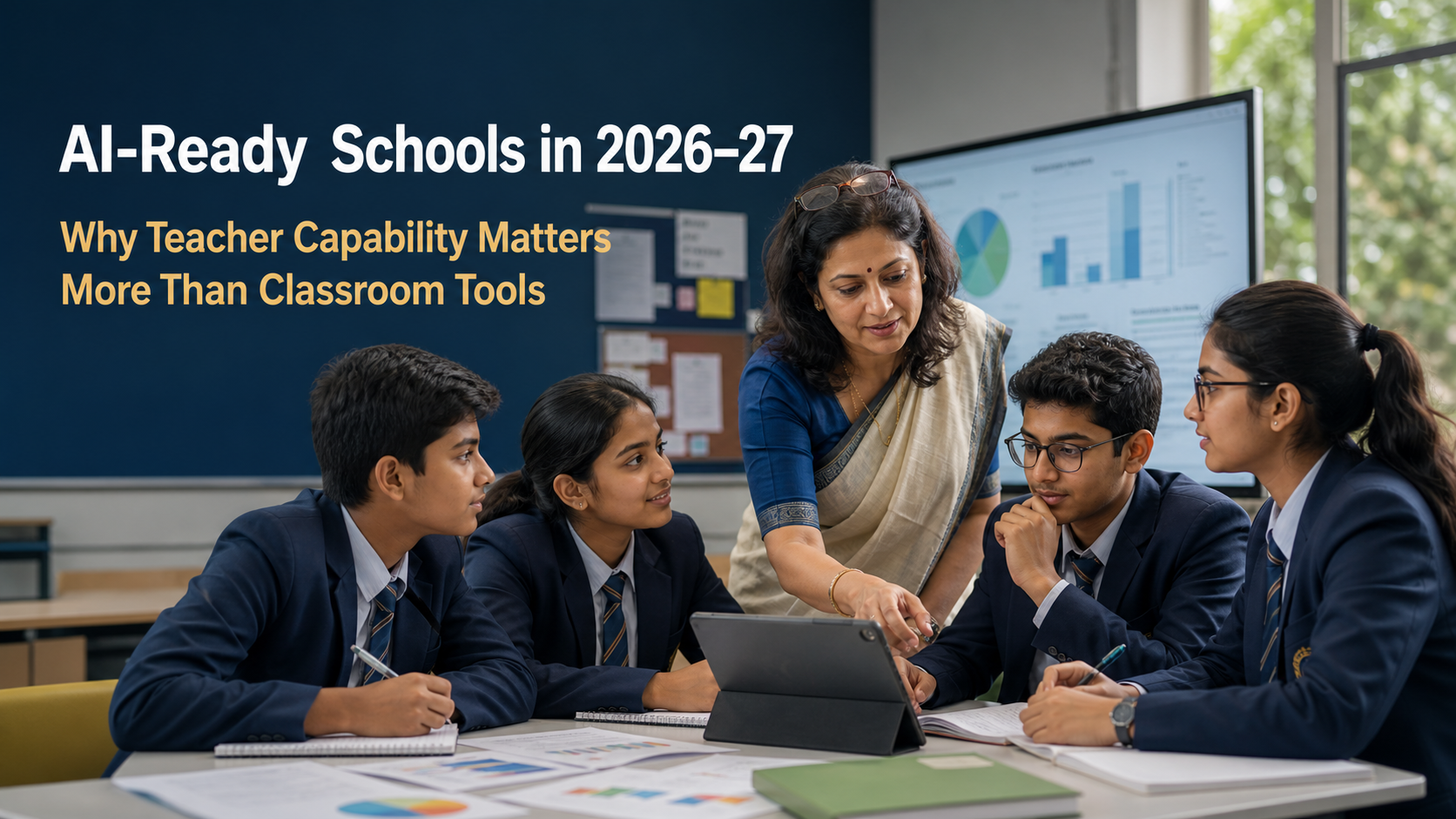
AI is entering the school timetable. A practical guide for school leaders on teacher development, assessment, cyber safety and responsible AI adoption in 2026–27.
Across India, school leaders are being asked versions of the same question: “What is our AI plan?” It is a fair question, but it can lead to the wrong first move. A school does not become AI-ready because it buys a platform, adds a chatbot to its website or conducts one staff workshop. It becomes AI-ready when teachers know where the technology adds value, where it does not, and how to keep learning honest, inclusive and safe.
The 2026–27 academic session makes this conversation more immediate. Artificial Intelligence and Computational Thinking are being introduced for Classes 3 to 8, while national programmes are expanding AI awareness and foundational skills for older learners and educators. For schools, the opportunity is real: better feedback, richer inquiry, more responsive planning and new ways for students to create. The responsibility is equally real: technology must strengthen sound teaching rather than distract from it.
That is why teacher capability matters more than classroom tools. The most useful question for a governing body or principal is not “Which AI tool should we adopt?” It is “What must our teachers, leaders and systems be able to do well when AI is available?”
Why 2026–27 is a turning point for AI readiness in schools
AI is moving from an optional enrichment topic into the wider school conversation. The policy direction is clear: learners need computational thinking, problem-solving, digital citizenship and the ability to engage critically with emerging technologies. Yet a curriculum announcement is not a classroom practice model. Teachers need time, examples, professional confidence and permission to ask difficult questions before they are expected to guide students.
There is also a practical reason to act now. Students are already using generative AI outside school—often more quickly than institutions can respond. They use it to draft homework, explain concepts, translate text, create images and search for answers. A school that does not set a thoughtful approach leaves every teacher to make policy alone. That creates inconsistency: one classroom may ban a tool entirely, another may rely on it without checking accuracy, and a third may never discuss it at all.
An AI readiness strategy for schools in India should bring those decisions into the open. It should help a school decide what it wants students to learn, what teachers may use, what evidence of learning still matters, and what safeguards should apply to data, privacy and wellbeing.
AI readiness is a teaching and leadership issue, not an IT purchase
Good technology teams are essential, but they cannot carry this change alone. A platform may be secure and well configured, yet still be used poorly if staff members do not understand its limits. Conversely, an experienced teacher can use a simple AI-assisted resource well when they have a clear learning objective, subject knowledge and professional judgement.
Consider a Grade 7 science lesson on ecosystems. An AI tool can help a teacher generate contrasting examples, create a starting quiz or suggest age-appropriate vocabulary. It cannot decide whether a misleading answer has entered the classroom, whether a student has understood cause and effect, or whether a discussion needs to slow down. That work remains human. The teacher plans the task, checks the output, asks the follow-up question and notices the student who has become silent.
This is the central idea behind teacher training for AI in education: use the technology to improve professional practice, not to reduce teaching to prompt-writing. The best professional development does not begin with a catalogue of apps. It begins with classroom problems teachers recognise—differentiation, formative feedback, lesson preparation, multilingual support, assessment design and student engagement.
Five capabilities every AI-ready school should build
1. A shared understanding of what AI can and cannot do
Teachers do not need to become engineers. They do need a practical understanding of how generative systems produce answers, why they can be confidently wrong, how bias can appear, and why source checking remains essential. A well-designed workshop should include live examples of inaccurate output, not just success stories. When staff see a plausible but wrong answer, they quickly understand why subject expertise and verification cannot be outsourced.
Students need this understanding too. AI literacy is not simply learning to use a tool; it is learning to question it. Who created the system? What information was it trained on? What may be missing? Can the answer be checked? These questions build intellectual independence—the outcome schools should protect most carefully.
2. Better lesson and assessment design
Assessment is where many schools feel the pressure first. If a student can obtain a polished answer in seconds, traditional take-home tasks can no longer be treated as complete evidence of learning. The answer is not to abandon writing or return to endless surveillance. It is to design a wider range of evidence: annotated drafts, oral explanations, in-class application, research logs, practical demonstrations, peer critique and reflection on how a tool was used.
For example, a history teacher might ask students to compare an AI-generated account of an event with two reliable sources, identify errors or omissions, and explain their judgement. The student is then assessed on reasoning, source evaluation and argument—not on whether they can make a chatbot sound fluent. This is a far stronger use of AI in schools because it raises the quality of thinking instead of hiding it.
3. Clear, workable guidance for staff and students
A one-page prohibition rarely survives the realities of school life. Staff and students need a practical policy that distinguishes between permitted, restricted and prohibited uses. It should cover homework, assessment, staff planning, parent communication, image generation, data entry, age-appropriateness and disclosure. It should also say what students must acknowledge when AI has helped them create or improve work.
The policy should feel usable on a busy Wednesday afternoon. A teacher should be able to ask: “May I paste this classroom information into a tool?” A student should be able to ask: “Can I use AI to brainstorm, and how do I show that I did?” When answers are clear, compliance becomes part of everyday professional practice rather than an afterthought.
4. Responsible data, privacy and cyber-safety practices
Schools handle information that deserves special care: student records, safeguarding notes, assessment information, family contact details and staff data. A public AI tool is not automatically an appropriate place for that information. Before introducing any platform, a school should know where data is stored, who can access it, whether it is retained, what the vendor promises about training its models, and how an incident would be reported.
This is where educational leadership needs strong partnership with IT. KaizenEd’s IT and cybersecurity support for schools can help institutions review their practical controls, vendor questions, access permissions and cyber-safety awareness. The aim is not to create fear around AI. It is to make deliberate decisions before a classroom experiment becomes a data-governance problem.
5. Leadership that creates space to learn
Teachers cannot develop confident practice when they believe one mistake will be treated as failure. Principals and academic leaders need to set expectations that are ambitious but realistic: try small, share what worked, identify what did not, and refine the approach. Pilot groups, subject champions and regular staff conversations are more effective than an all-school rollout based on a single demonstration.
Leadership also decides whether AI reinforces inequality or reduces it. Schools should consider device access, connectivity, language, accessibility needs and the danger of rewarding students who already have more technology at home. An AI programme that is technically impressive but unavailable to part of the student body is not future-ready; it is simply uneven.
What a practical first year can look like
Schools do not need to solve every question at once. A staged approach is more sustainable.
First 30 days: listen and map
Start with an honest baseline. What AI tools are teachers and students already using? Which departments are confident, and which need support? What concerns have parents raised? Which existing data or technology policies apply? A short internal survey, a staff listening session and a review of current platforms will often reveal more than a large external purchase.
Days 31–60: build a small professional learning programme
Choose a small group of teachers from different subjects and stages. Give them a focused learning sequence: how generative AI works, how to verify outputs, how to design an AI-aware assessment and how to protect personal information. Ask each participant to test one modest classroom use case. The purpose is evidence, not spectacle.
Days 61–90: pilot, reflect and publish guidance
Collect examples from the pilot. What improved? Where did a tool produce weak or unreliable work? Which student questions emerged? Use that experience to create a simple staff-and-student guide. This is also the right point to set a review cycle for vendors, permissions and assessment practices.
Schools that need help moving from discussion to an implementation plan can draw on KaizenEd’s education consulting services. The work can connect professional development, institutional strategy and day-to-day classroom practice, rather than leaving each strand in a separate department.
Common mistakes to avoid
Treating AI as a substitute for good teaching
AI can accelerate preparation, offer multiple examples and support differentiation. It cannot replace the relationships, observation and judgement that define effective teaching. Schools should be wary of promises that technology will solve complex learning challenges without sustained investment in teachers.
Writing a policy without building confidence
A policy has limited value if staff members do not know how to apply it. Professional learning, examples and ongoing coaching should accompany every guidance document. The best policy is one teachers can explain in their own words.
Ignoring academic integrity until an incident happens
Students need clear, age-appropriate guidance before assessments are submitted. Explain the difference between brainstorming, editing, copying and misrepresenting work. Make room for reflection, process evidence and conversation. This protects standards while teaching students how responsible use works in the real world.
Forgetting the parent partnership
Parents often hear about AI through headlines—some exciting, some alarming. A short parent session or plain-language guide can explain how the school will approach tools, privacy, assessment and screen time. It turns uncertainty into a more constructive conversation.
Questions school leaders are asking
Should every teacher use AI in 2026–27?
No. A school should set a common standard for safe and responsible practice, then allow adoption to grow through relevant classroom use cases. A primary teacher, a counsellor and a senior mathematics teacher will not need the same tools or the same pace of experimentation. What matters is shared understanding and informed choice.
Can AI make assessment fairer?
It can help create varied practice questions, support feedback and identify patterns that merit teacher attention. It should not become an unexamined judge of a learner. Fair assessment still depends on transparent criteria, professional review, opportunities to explain work and awareness that automated outputs can contain bias or error.
What is the right first investment?
For most schools, the first investment is a focused teacher-development programme and a careful review of existing tools—not another licence. Once staff have agreed priorities, the school can evaluate vendors against real needs, privacy expectations and the ability to support teaching over time.
From AI tools to AI-ready learning communities
The phrase “AI-ready school” should not describe a building full of screens. It should describe a learning community where teachers can make informed choices, students can think critically, leaders can govern technology responsibly and families understand the school’s direction.
That is a much more demanding ambition than buying a subscription—but it is also much more valuable. It keeps the focus on learning. It recognises that new tools will keep arriving and that no single platform will define the future of education. A school with confident teachers, clear values and strong systems can adapt. A school that relies only on a tool will have to start again each time the tool changes.
For institutions planning their next step, KaizenEd can support a structured conversation around teacher development, AI-aware classroom practice, educational leadership and secure technology adoption. Start a conversation with the KaizenEd team about building an approach that fits your learners, staff and long-term goals.
This article is intended as general educational information. Each school should consider its own policies, student context, technology environment and applicable regulatory requirements before adopting a specific tool or approach.