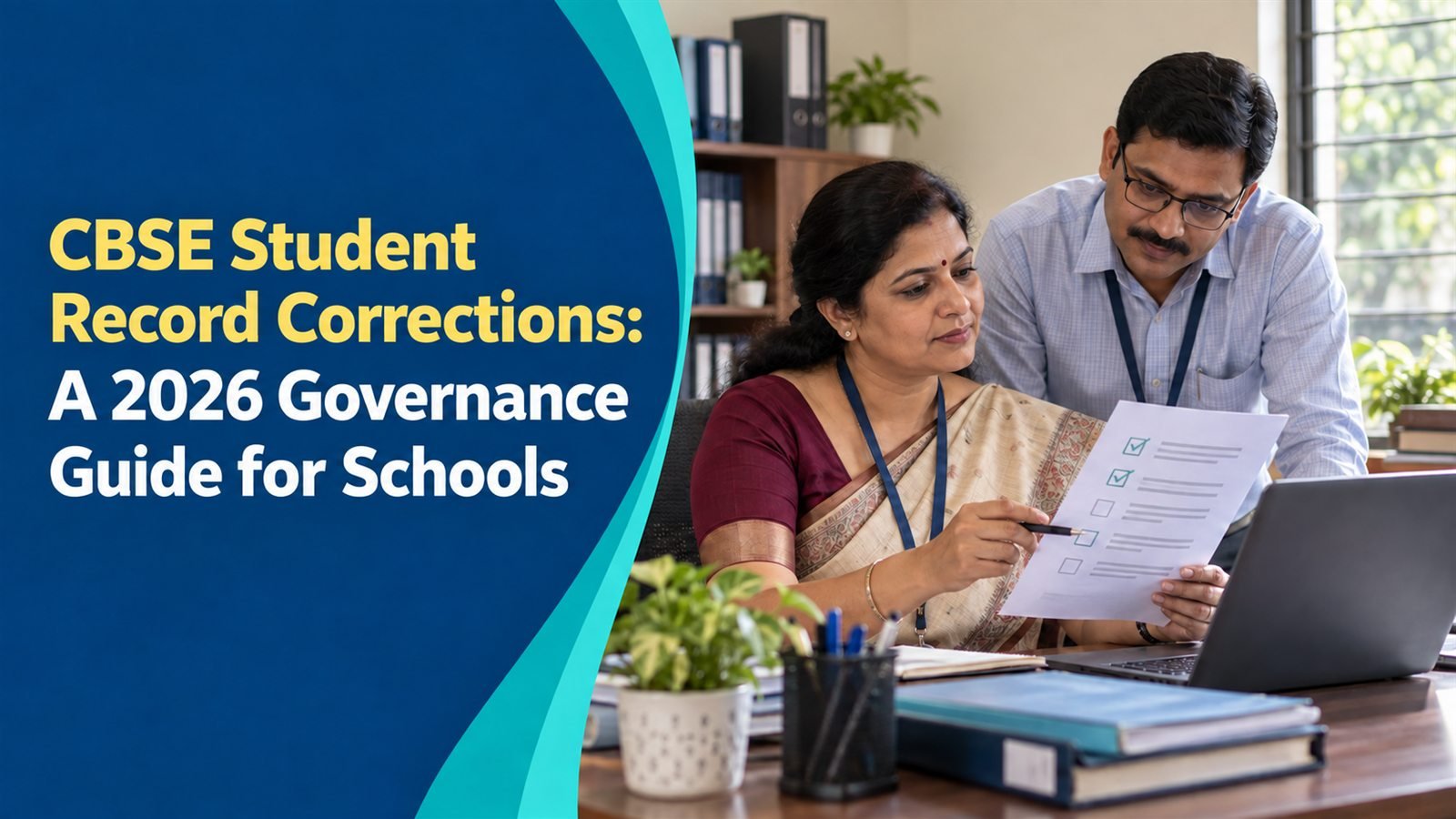
A practical school-governance framework for accurate demographic records, certified evidence, parent verification and complete CBSE correction requests.
A student's name, date of birth or parent details can pass through years of school records before a mismatch appears on a Board document. By then, what began as a small entry error may affect admissions, identity checks, scholarships or future employment. On 23 September 2026, CBSE issued fresh directions to affiliated schools after observing that many requests for demographic corrections were incomplete, poorly documented or unsupported by records from previous schools.
The circular is not simply about handling corrections faster. It points to a wider leadership responsibility: schools must maintain accurate records from admission onward, give families meaningful opportunities to verify them, preserve reliable evidence and submit complete certified requests when a correction is genuinely needed. That requires a records-governance system, not a last-minute letter to the Board.
What CBSE's 23 September circular says
The official CBSE circular on demographic corrections is addressed to principals and heads of affiliated schools. It reiterates the sequence through which student details are recorded and checked: admission forms and school registers, transfer certificates, Class IX registration, the registration correction window, registration cards, LOC submission, the LOC correction window, admit cards and passing documents.
CBSE notes that this sequence is repeated in Classes XI and XII and provides schools and parents with about 20 opportunities to confirm correct demographic details. Despite these checks, the Board continues to receive many correction requests after results are declared.
The circular identifies recurring problems. Requests arrive incomplete. Records from all previous schools are missing. Documents are illegible or contain numerous cuttings. When CBSE asks for further material, some schools do not respond. These failures delay decisions and shift avoidable stress to students and families.
CBSE therefore directs schools to keep demographic details accurate in all school records, follow registration and LOC instructions, obtain parent confirmation and send certified records from every previous school with a correction request. It also states that incomplete requests will be summarily rejected. Students should be guided to route requests through their schools rather than sending them directly to CBSE, through legal notices or by immediately approaching courts, because the necessary school records may otherwise be unavailable.
This is different from an LOC checklist
LOC submission is an important checkpoint, but the 23 September directions look across the entire student-record life cycle. A school can upload an accurate LOC only if admission records, transfer documents and earlier registration data are already reliable. A correction process can succeed only if the institution can reconstruct that history with legible, certified evidence.
School leaders should therefore treat demographic accuracy as part of institutional governance. The work begins when a student applies for admission and continues through transfers, registration, examination, certification and alumni requests. Strong education consulting and school-governance practice connects these stages rather than leaving each office to maintain a separate version of the truth.
Define the authoritative record for every field
Names and dates are often copied from informal sources: a messaging-group list, a prior spreadsheet, a handwritten class register or a form completed from memory. Small differences then multiply. The school should define which record controls each demographic field and what evidence is required to change it.
A record dictionary can cover the student's full name, parents' or guardian's names, date of birth, gender and other applicable identity fields. For each item, specify the authoritative source, permitted format, staff role allowed to enter it, reviewer, evidence retained and downstream systems that must be updated. The admission form, scholar register and Admission and Withdrawal Register should agree; where they do not, the difference should be resolved and documented rather than silently copied forward.
Transliteration, spacing, initials, honorifics and reordered names deserve particular attention. A system may accept an entry that is technically valid while still differing from the evidence families expect to use later. The goal is not merely a complete field; it is a consistent, evidence-backed identity record.
Build verification into the student journey
At admission
Show the family exactly how key details will appear in school records. A second staff member should compare the entry against the submitted evidence before the student record is activated. If an earlier school is involved, retain the transfer certificate and the relevant certified records in a legible form.
At Class IX and XI registration
Generate a readable verification sheet rather than asking a parent to approve a dense portal screenshot. Highlight the fields that will appear on examination documents. Record the date, method and person confirming the information, and preserve any correction made during the available window.
Before LOC submission and admit cards
Compare registration data with the current authoritative records. Do not treat a parent's earlier signature as permanent approval if the school has since received a correction or supporting document. When an admit card is issued, give the student and family enough time to check it before examination pressure takes over.
When passing documents are received
Use a documented handover process and obtain confirmation after the family has actually reviewed the demographic details. A signature collected as a distribution formality is not meaningful verification. Explain where an error should be reported and which documents will be required.
A correction-request workflow that can withstand scrutiny
When a discrepancy is reported, the school should open a case record with a unique reference rather than manage the issue through scattered email and messaging. The workflow can follow six stages.
1. Classify the request
Identify the exact field, the current entry, the requested entry and the stage at which the difference first appeared. Distinguish a clerical mismatch from a requested change in the underlying particulars. The applicable CBSE rules, evidence and route may differ.
2. Reconstruct the record history
Trace the detail through the admission form, scholar register, Admission and Withdrawal Register, previous-school documents, registration card, LOC verification, admit card and passing certificate. Note every point of agreement or divergence. This chronology allows the principal to understand whether the school introduced the error, inherited it or received inconsistent instructions.
3. Collect records from all previous schools
The new circular specifically calls for certified records from every previous school where the student studied. A current school should not wait until the request is ready to submit before seeking them. Contact the earlier institution through an official channel, identify the records needed, verify the certification and log follow-ups.
4. Check legibility and integrity
Scan complete pages at a readable resolution. Avoid cropped seals, missing reverse sides, dark shadows or compressed images that obscure dates and entries. Documents containing overwriting or cuttings should be explained and supported by clean source records where possible. Never improve a scan in a way that changes its evidentiary appearance.
5. Certify and review the complete file
Use a maker-checker process. One authorised employee assembles the chronology and indexed documents; another verifies them against the originals. The principal should receive a concise case note stating the request, evidence, previous verifications, unresolved issues and proposed submission.
6. Submit, track and answer promptly
Send the request through the prescribed school channel, retain proof of submission and name an owner for any CBSE query. The circular's observation that schools sometimes fail to reply is a governance warning. A central tracker should show the case status, last action, next due date and person responsible until closure.
Keep the process helpful for families
Routing requests through schools should not become a barrier. The school holds records that the student may not possess and is therefore best placed to present a complete history. It should explain the process in plain language, acknowledge the request, provide a document checklist, identify any missing evidence and give realistic status updates.
A family may arrive frustrated because the error has already affected an application. Staff should avoid blame and focus first on preserving deadlines and gathering facts. If the requested change cannot be supported, the school should clearly explain the record conflict and the rule being applied. A transparent refusal is more useful than silence.
Escalation routes should remain available for exceptional or time-sensitive cases. The circular's advice against starting with direct representations, legal notices or litigation does not remove anyone's legal rights; it reflects the practical need to place the underlying school records before the decision-maker.
Protect the data while proving it
A correction file may contain birth certificates, transfer certificates, identity documents, addresses, signatures and information about family relationships. Copying the entire file into personal email accounts or messaging groups creates a second problem while trying to solve the first.
Schools should store cases in an institution-controlled repository with role-based access. Use a standard naming convention and version history, restrict downloads, encrypt transfers where available and record who reviewed or certified each document. Staff should send only the evidence necessary for the request and follow the school's retention schedule when the matter closes.
These controls belong within a broader school IT, cybersecurity and student-data responsibility framework. Accuracy, privacy and security are not competing objectives. A controlled record is easier to verify, and a verified record generates fewer uncontrolled correction files.
A principal's monthly records dashboard
Leaders do not need to inspect every document personally, but they should see whether the system is working. A short dashboard can include:
- new admissions awaiting second-person demographic verification;
- registration or LOC records awaiting parent confirmation;
- open mismatches between the admission register and digital systems;
- correction cases by stage and number of days open;
- requests waiting for records from previous schools;
- CBSE queries awaiting a response;
- files failing the legibility or certification check; and
- closed cases with lessons requiring a process change.
The dashboard should reveal recurring causes. If name-format errors come from one admission form, redesign the form. If parent confirmations arrive late, move the internal deadline. If previous-school records are repeatedly missing, create a transfer-admission control. Improvement comes from removing the source of errors, not simply processing more corrections.
A 30-day implementation plan
Week 1: assign ownership
Name a records owner, correction-case coordinator, data-protection contact and principal-level reviewer. Map which departments create or change demographic information.
Week 2: standardise evidence and verification
Create the record dictionary, parent verification sheet, correction intake form, evidence checklist and case chronology template. Define certification and scan-quality standards.
Week 3: audit a sample
Review a risk-based sample across entry years and transfers. Compare core fields through physical and digital records. Resolve exceptions while the necessary evidence is still accessible.
Week 4: train and monitor
Run a short scenario-based session for admission, examination, records and IT staff. Test one mock correction case from intake to submission. Launch the dashboard and review it monthly.
The institutional takeaway
CBSE's September 2026 directions make one point unmistakable: a correction request is only as strong as the records behind it. Schools cannot compensate for incomplete history, unreadable evidence or missed follow-up with an urgent covering letter at the end.
The better approach is preventive and humane. Establish one authoritative record, verify it at meaningful checkpoints, preserve certified evidence, protect sensitive data and give every correction case a responsible owner. That reduces administrative delay, but more importantly, it prevents a student's future from being disrupted by an error the institution had many opportunities to catch.
This article is an educational implementation guide based on CBSE information publicly available as at 29 September 2026. Schools should read the complete current circular and applicable CBSE rules, bye-laws, portal instructions and Regional Office directions before acting. Individual correction requests may require case-specific documentary or legal review.