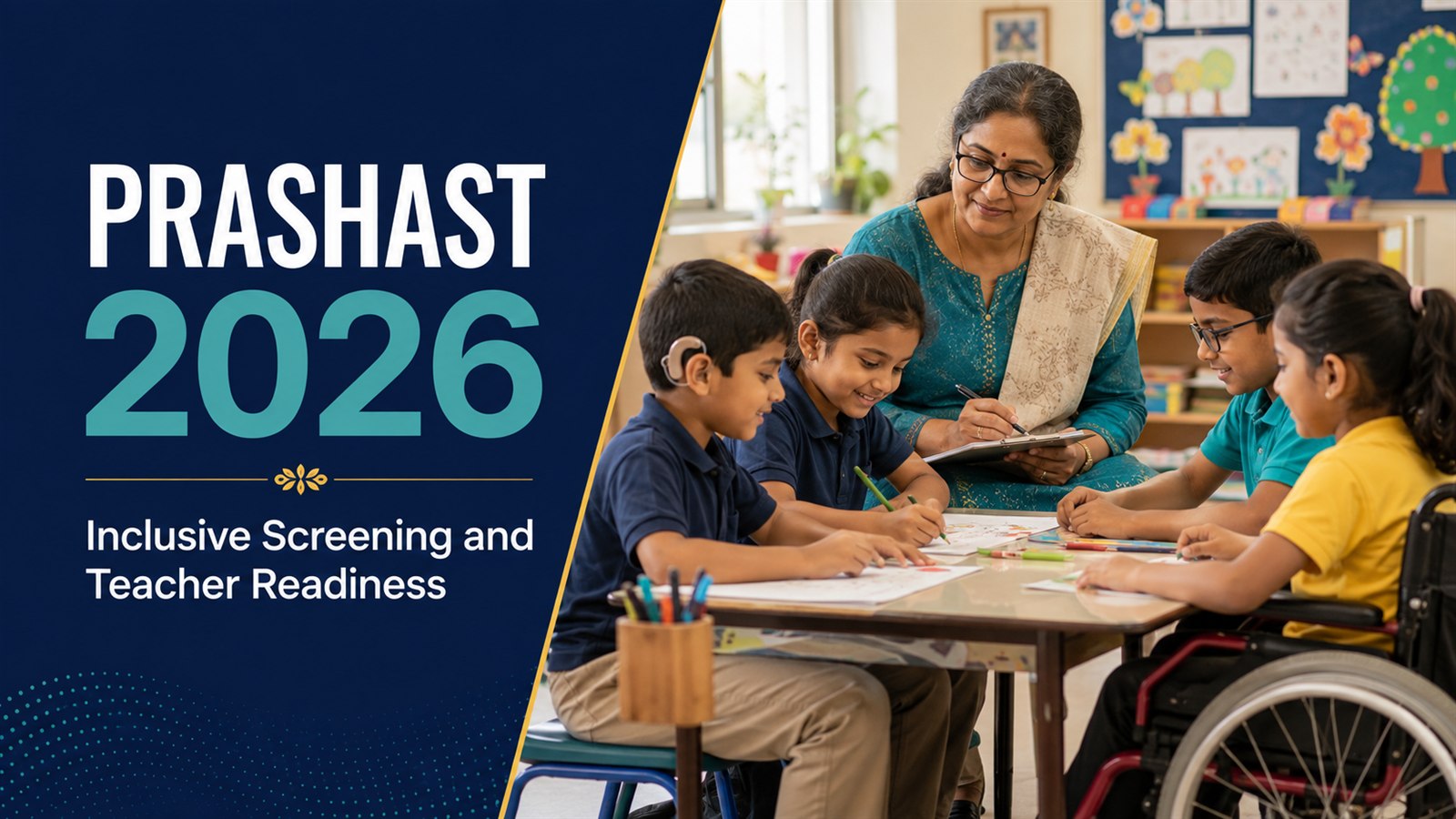
A practical implementation guide for school leaders on PRASHAST screening, teacher preparation, family communication, student-data care and meaningful follow-up.
Inclusion often fails for a surprisingly ordinary reason: a child struggles quietly for months before anyone joins the dots. A teacher notices incomplete work. A parent sees reluctance at home. The sports teacher observes balance or coordination difficulties. Each observation sits in a separate place, and support begins only after the difficulty has affected confidence, attendance or learning.
PRASHAST offers schools a more systematic starting point. Developed as a school-based screening tool for disability conditions recognised under the Rights of Persons with Disabilities Act, 2016, it helps teachers record observations, identify patterns and guide children towards appropriate follow-up. Its 2026 implementation calendar puts teacher training and school readiness at the centre of the process.
That distinction is important: PRASHAST is a screening tool, not a classroom diagnosis. Its value depends less on completing a form and more on how responsibly a school prepares teachers, communicates with families, protects information and follows through after a concern is noticed.
Why PRASHAST 2026 deserves leadership attention
For schools participating in the 2026 cycle, the official timeline moves from training and onboarding to Part 1 and Part 2 screening, intervention camps, progress monitoring and outcome evaluation. This makes PRASHAST more than a one-day exercise. It is a sequence of leadership decisions involving timetables, staff roles, parent communication, documentation, referrals and classroom support.
The broader lesson applies even beyond schools formally using the platform. Inclusive education improves when early observation is built into routine teaching and when staff know what to do next. A teacher who spots a possible barrier but has no referral path is left carrying an impossible responsibility. A principal who collects screening data without preparing classroom support has completed an administrative task, not an inclusion process.
KaizenEd's work in educational consulting and teacher development begins from this practical reality: tools become useful only when people, routines and leadership decisions support them.
What PRASHAST is—and what it is not
PRASHAST supports school-based screening across the disability conditions included in the RPwD Act. It gives teachers a structured way to note observable indicators and helps schools identify children who may benefit from closer assessment or support.
Screening does not establish a medical or legal diagnosis. Teachers should not attach labels, announce conclusions or promise a particular certification. Their role is to observe carefully, record consistently, discuss concerns through the school's authorised process and support referral to qualified professionals where appropriate.
This boundary protects everyone. It protects the child from premature labelling, the family from confusing or alarming messages, and the teacher from being asked to make decisions beyond professional scope.
The real work begins before the first screening
Build a small implementation team
A principal should not treat PRASHAST as a form to be forwarded to one enthusiastic teacher. A workable implementation team might include the school head, an inclusion or special-education lead where available, class teachers, a counsellor, the IT/data person and a designated family-contact lead. Smaller schools can combine roles, but responsibilities should still be explicit.
The team needs answers to basic questions: Who coordinates training? Who checks that observations are complete? Who may view sensitive information? Who speaks with parents? Who maintains referral contacts? Who follows up when an intervention is recommended?
Give teachers protected learning time
A briefing sent on a messaging group is not training. Teachers need time to understand the purpose of screening, work through indicators, discuss ambiguous examples and practise neutral observation. Short case discussions are especially useful because they reveal how easily behaviour can be misread.
For example, unfinished written work may reflect a vision difficulty, fine-motor challenge, language barrier, anxiety, unclear instruction or simple lack of time. Screening should encourage attention, not instant conclusions.
Agree on respectful language
Every adult involved should use person-respecting, non-stigmatising language. Staff should describe what they observe rather than describing a child as “weak”, “slow”, “careless” or “problematic”. A useful observation is specific: “requires repeated verbal directions during multi-step tasks” or “moves text very close while reading”. It avoids judgement and makes later discussion more reliable.
Observation must happen in context
A single moment rarely tells the whole story. Teachers should look for patterns across lessons, days and settings. Does the difficulty appear only during writing? Does it change when instructions are visual? Is the child comfortable in a smaller group? Has attendance, language exposure or a recent change at home affected participation?
Good screening combines structured indicators with professional curiosity. It also draws on more than one adult's perspective where possible. The class teacher, language teacher, sports teacher and art teacher may see different strengths and barriers. The goal is not to accumulate negative evidence; it is to understand what conditions help the learner participate.
Family communication can make or break trust
Parents should not first hear about PRASHAST through a vague message saying their child has been “identified”. Schools need a prepared communication process that explains the purpose of screening, its limits, the next step and the family's role.
A constructive conversation might begin with the child's strengths, share clear observations without diagnosis, invite the parent's experience and explain what support the school can offer immediately. Families may have important information about health, language, routines or previous assessments. They may also carry understandable anxiety about stigma. Listening is part of implementation, not a courtesy added at the end.
Schools should provide a named contact person and a realistic timeline for follow-up. A parent should not have to repeat a sensitive story to several departments simply because internal responsibilities were unclear.
Protecting student information
Screening records concern children and may contain sensitive educational or health-related observations. Access should be limited to authorised staff with a genuine role in support. Schools should decide where records are stored, how access is controlled, whether information is downloaded or printed, how long it is retained and how it is shared with external professionals.
Teachers should not post identifiable screening details in open staff messaging groups or keep uncontrolled copies on personal devices. If the implementation uses shared systems, practical safeguards belong in the school's process design. KaizenEd's IT and cybersecurity guidance for educational institutions connects technology decisions with the daily behaviour of the people handling student information.
What should happen after a concern is identified?
The worst outcome is a completed screening process followed by silence. Before screening begins, schools should map the next steps available in their context. These may include classroom accommodations, discussion with a special educator, referral to an authorised assessment service, consultation with health professionals, or contact with the appropriate government support mechanism.
Some classroom supports do not need to wait for a formal diagnosis. Depending on the child's observed needs and school policy, a teacher may clarify instructions, reduce visual clutter, allow additional processing time, change seating, use multiple ways to demonstrate learning, provide movement breaks or check understanding privately. These are thoughtful teaching responses, not substitutes for professional assessment.
Follow-up should answer three questions:
- What barrier was observed, and in which contexts?
- What support or referral was agreed, by whom and by when?
- What change will the school look for when progress is reviewed?
A 90-day implementation plan for school leaders
Days 1–15: prepare the ground
- Nominate the implementation team and a single accountable lead.
- Review the official PRASHAST guidance and the 2026 timeline relevant to the school.
- Map existing inclusion, counselling, referral and data-protection arrangements.
- Prepare staff and parent communication in plain language.
- Identify training gaps and schedule protected teacher-learning time.
Days 16–45: train and observe
- Run scenario-based training rather than a slide-only briefing.
- Practise distinguishing observable facts from assumptions.
- Agree how teachers will seek a second observation when indicators are unclear.
- Begin the required screening stage without turning it into a race for completion.
- Hold short weekly check-ins to resolve process questions.
Days 46–70: communicate and connect support
- Review flagged observations through the authorised school team.
- Speak with families privately and respectfully.
- Start appropriate classroom adjustments.
- Activate referral routes where further assessment is indicated.
- Record actions, ownership and review dates—not just screening outcomes.
Days 71–90: review the system
- Check whether children received the support discussed.
- Ask teachers which indicators or processes remained confusing.
- Review access to screening records and remove unnecessary copies.
- Examine participation and learning evidence without reducing success to a single test score.
- Share process improvements with staff and families.
Common implementation mistakes
Treating completion as success
A dashboard can show that every class has completed screening while children still wait for support. Leaders should track the quality and timeliness of follow-up, not only the number of forms submitted.
Training only the inclusion specialist
The specialist may coordinate, but everyday observation belongs to classroom life. Every relevant teacher needs enough understanding to participate responsibly.
Looking only for difficulties
Observation should include strengths, interests and successful conditions. A learner who struggles with extended writing may explain ideas clearly through speech, models or demonstrations. Strengths help the school design support that preserves dignity and motivation.
Using labels in staff conversation
Informal labels spread quickly and can influence expectations long after the original observation. Schools need explicit norms for confidential, evidence-based discussion.
Buying technology before designing the process
A new app does not decide who follows up with a family or how a teacher adapts tomorrow's lesson. Define people, permissions and actions first; choose technology that serves the process.
How to know whether implementation is working
Useful measures are practical and balanced. School leaders can monitor teacher training completion, quality of observation records, time from concern to family conversation, time from concern to support, referral completion, use of classroom accommodations and evidence of learner participation. Qualitative feedback from children, families and teachers is equally important.
Success should not mean that a school identifies the highest number of children. It should mean that concerns are noticed responsibly, support is connected sooner and learners experience fewer avoidable barriers.
PRASHAST as a culture test
PRASHAST 2026 may begin with a structured tool, but its deeper test is cultural. Do teachers feel safe asking for help when they are unsure? Can parents raise a concern without fear of blame? Are records handled with care? Does the timetable make room for intervention? Do leaders treat inclusion as teaching quality rather than a specialist department's responsibility?
Schools that answer these questions honestly can use screening as the beginning of better teaching. Those that focus only on compliance risk producing records without changing a child's day.
KaizenEd works with schools and educational institutions on teacher capability, implementation planning and responsible technology integration. To discuss an inclusion-readiness review or a focused teacher-development programme, start a conversation with the KaizenEd team.
This article is an educational implementation guide based on publicly available information as at September 2026. Schools should follow the current official PRASHAST guidance and applicable directions and should use qualified professionals for diagnosis or clinical assessment.